Sunday, 3 January 2016

A LEGAL UNION OF PUBLIC AND PRIVATE SECTOR FOR A SUSTAINABLE ECONOMY

I like to liken public-private sectorpartnership to marriage. The man (government/public sector) is the head. No matter how rich the woman (private sector) is, she still has to submit to the head.

As the head of the family, any decision taken by the man will directly affect the woman. Restrictions such as the type of friends the woman will have (partners; local and international), what the woman can buy (trade restrictions) and the amount of contributions the woman must make towards the running of the family (tax) will determine how successful the woman will become (successful entrepreneurs) and in extension, the amount of children she will have or be willing to have (employment creation).

Every business is created for the sole purpose of making profit and when this goal appears threatened by a policy with no close alternative, there will always be a protest in one way or the other.

In playing fatherly role, government should not make policies that will drop down the throat of private sectors like a crusted garri, rather, they should be presented with choice with the odds favouring the direction the government wishes it to go. For example, instead of just banning the importation, manufacture and sell of generating sets as alternative to erratic power supply (especially in sub-Saharan Africa where power is a major issue), government could decide to increase the tax on such products and decrease that of the clean energy alternative which the government seek to promote.

Like a submissive wife, what will follow is a gradual but steady phasing out of the former because it would become expensive to run and less profitable (an abrasion to business ideology’s lower cost and increase profit). Who says the same technique cannot be applied to every other part of the economy to encourage the private sector to embrace more eco-friendly means of doing business?

The global fall in oil price can be a blessing in disguise. Governments globally can decide to pull out from subsidizing oil for her citizens and channel it to subsidizing public transports so that it becomes very expensive to drive a private car. This will get many cars off the road (which are CO2 emitters) and create employment for the populace (as public transport drivers).

Having it at the back of mind that a great economy is driven by the private sector, it is pertinent for government policies to reach the private sector as friendly out-stretched arm. The pursuit of a sustainable economy may be a slow climb but definitely not a hopeless case. What if wood and paper industries are mandated to grow all the timber they use? What if there is a contest that rewards the fisherman with the largest pond? What if the cost of obtaining raw plastic/rubber becomes too high that it becomes cheaper to pay people to return used plastics? All these points to one direction; make businesses think sustainability right?

Part of the friction in public-private agreement is information gap. When the private sector is involved in government decision making process, they will have a better understanding to WHY it is necessary to do things differently (government too will understand the challenges and fears of these sectors and together they sit to proffer ways to make the transition hassle-free) and there is a better chance that businesses will want to be a part of the process rather than against it. 

This is my contribution to 2016 Masdar Engage Blogging Contest 

Sunday, 13 December 2015

NOW THAT BVN IS OVER...

The bank verification number is one of the CBN policies that got Nigerians on their toes. Though the program was launched on February 14th 2014, most Nigerians took the process serious when the first deadline (June 30th 2015) drew close. The population made CBN to extend the date to 31st October 2015. Customers besieged banking halls to enroll since it was learned that those who failed to be captured would lose access to their accounts.
                                                       
Bank Verification Number (BVN) is a ten digit number given to a customer after their biometric details have been captured. To secure BVN, a customer’s portrait needs to be taken, their fingerprints captured and then their signature using a special pen and glass. The beauty of BVN is that it guards against identity theft and a customer’s details can be verified across all the banks in the country (not just the bank they enrolled with).

The benefits of the BVN cannot be over emphasized but there are still begging questions desirous of answers. A typical Nigerian is yet to understand how the process can guard them from fraudsters. Moreover, verifications are mostly required when huge transactions are involved. As online banking and marketing gains wider acceptance, swindlers are constantly gaining an edge over illiterate and ill exposed Nigerians.

Recently, I got a message with the title of the sender being "CBN". That caught my fancy. The message claimed that because of BVN my ATM has been blocked (and it has been blocked before so I took it serious) that I should call a certain number if I wish to unblock it. I called the number and the caller told me I had to verify I was the real owner of the card so I should answer some questions.

I said my name, my date of birth, called out my card number and the expiry date (well, I saw those as somewhat safe information to give out) it was when the caller told me to call out the three security numbers at the back of my card I figure it was fraudulent and ended the call. I was lucky by a bird’s hair; that close to getting my account emptied.

This is where I think BVN should be helpful to all Nigerians (and world over) to totally eradicate internet fraud of this sort. Since every customer’s details including fingerprint is already in a database, what if a new trading platform for online transactions is designed such that after filling in the card information, the customer still needs to thumbprint for the transaction to be carried out?

This will definitely end fraudsters from carrying out transaction for their victims. It doesn’t end there. What if we fast-track to a point where ATM has a provision for thumbprint too? It will bring to an end the era of criminals stealing and hacking people’s ATM cards (unless they’ll decide to take their victim’s thumb along).

These solutions may sound like hocus-pocus but I believe it will work (if the person in the right position to effect this change is reading this and thinks in tandem with me) and when it does work, customers will need to physically monitor their off-the-banking-hall transactions. I also believe this is the best way to secure an illiterate Nigerian from financial theft and justify the long hours they spent under harsh condition to get their BVN.

Sunday, 18 October 2015

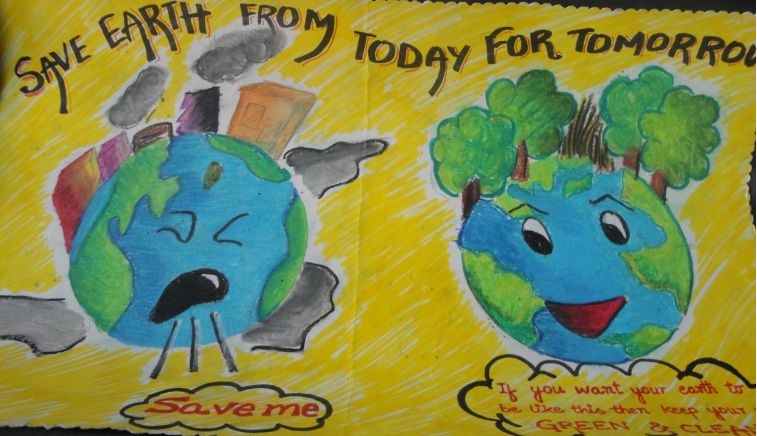
7 BILLION DREAMS, 1 PLANET


Up until I joined tunza.eco-generation.org I never knew World Earth Day (WED) was celebrated every April 22 nor was I aware that there was anything like World Environment Day (June 5) or World Water Day (March 22). The truth was that I never cared.

I first discovered tunza.eco-generation.org two year ago while rummaging the web for any ongoing essay and short story contests that Nigerians can (an opportunity I always grabbed to sharpen my writing skills and also evaluate myself). At that time, I was concerned about a number of things; if my writing actually made sense, how people felt about my work. My idea was that if I should win any contest or even get short-listed, it meant I was doing great (that never happened. An awful way to evaluate oneself).

Meanwhile, I decided to read a few articles on the website (there is always something new to read every day by the way). When I did, I found a new purpose to life greater than my hunt for bounty; our planet is dying and I was one of the murderers.

Like myself, there are millions of people out there who are unaware of how their behaviours change our planet. Many years ago, I knew the exact month to expect the rains, when it will stop and when harmattan will take over the mantle of leadership but that is no longer so.

Climates have change; earthquakes, volcanic eruptions, tsunami, erosions and melting of glaciers have taken over our environment. Why won’t the earth be annoyed? We keep taking and never give. Caring for the earth is not a government thing but the responsibility of everyone.

Yes, we have to cut down trees for timber, but what stops us from planting another to replace the one cut down? Why acquire more than you need and end up discarding many of them? Why can’t industries figure out better ways to manage their waste rather than dumping them into the sea? Why must we burn coal and fuel when the sun is there to give us cleaner energy?

The most disturbing and most prevalent especially in Nigeria is the culture of wastage (to show the world that you have ‘arrived’). People throw lavish parties with lots of food and drinks spilled. Same is the case every evening at drinking joints. People eat and drink and become drunk, leaving foods on their plate which are later collected into a dustbin.

At no other time has this crusade of attitudinal change been more relevant than today when parts of the world are gripping with food shortage. Even in Nigeria, there are still families that go to bed on empty stomach. The truth is that the earth is capable of supporting everyone’s dream but not their greed. We have approximately 7 billion people in the world in one planet, so consume with care.

I used to think I was an individual, what difference can I possibly make? But going through tunza.eco-generation.org I got ashamed of myself; youngsters––as young as fifteen and under––raising their words and living the talk to make our environment a better place. You may be just one person in 7 billion but believe me, there are tens of people that look up to you to model their lives. Live the change and it will trickle down.

More recently, an ambassador on the platform (Miss Bindu Bhandari) wrote about her interview with what she tagged ‘the real Eco-hero’. It was about a man, a refuse collector that goes ahead to sell the scraps he picked from the environment to recycling plants so as to generate money for his family’s upkeep. The people that do this kind of job are the ones we most often look down on but through her interview I discovered otherwise.

The action of the man helps remove wastes that are not biodegradable from the environment. If not for this great website, tunza.eco-generation.org I may still be basking in my ignorance environmental matters.

To end this write-up, I want to dish out 5 pieces of advice;
1) Don’t let a year pass without planting a tree or flower.
2) Reduce; while you dine, remember there are people out there who can’t afford to.
3) Re-use; all the old plastic and tyres can be put into other uses.
4) Insist on clean energy
5) Recycle; to reduce the rate at which new raw materials are mined


That refuse scavenger in you vicinity is an Eco-Hero. Who are you?

photo credit: Arushi Madan on tunza.eco-generation.org

Thursday, 13 August 2015

EMERGING FROM THE DARK AGE


The dark age in Nigerian history to me was not the period between 1967 and 70 when Nigerians raised arms against Nigerians in a bloody civil war. The darkest hour for Nigerians was from the late eighties to nineties. During that period, Nigerians became more aware of the possibilities technology could bring and yearned for more of such information but sadly, information was costly to get. Only elites could afford to offset the huge naira needed to get an internet connection (the window to endless information).

A lot of problems plagued that era basically because of lack of information. I recall like it was yesterday when HIV/AIDS became a pandemic in Nigeria; a section believed it was a diabolic disease sent to people by their enemies. The discrimination against people living with the disease was unimaginable. So bad it was that at some point I feared shaking hands with anyone that was lank because I wasn't sure how I could go wrong. In rural areas, cases were reported of people who believed they would be cured by sleeping with infants (besides ending behind bars, I don't know how that played out with their infection).

Endemic sub-Saharan diseases like malaria, cholera and typhoid fever took the lives of many (and probably still do in rural areas) because little was known of their mode of transmission and prevention. It is not surprising how the mantra, 'disease no dey kill African pikin,' born by ignorance quickly gained acceptance.

As technology advanced and information became nearer grasp, farmers didn't need to practice their career blindly. There came meteorologist that didn't just guess the weather but said with a high degree of precision how the weather would play out the entire year; the amount of rainfall and drought. This helped to reduce the amount of seed plants lost to flood and drought hence more fruitful harvest and better food security to the nation.

The advent of cheaper data (orchestrated by launch of indigenous satellite into space) proved that our actions were driven by ignorance. Information pertaining the vector and mode of transmission of some of the common diseases became an easy and verifiable read from the internet rather than mere speculations. There was an obvious decline in the amount of deaths recorded on those diseases from the year two thousand and five upwards. 

More recently, there was an Ebola outbreak in some West African states. When it came to Nigeria however, it was defeated, it was defeated. It wasn't defeated by drugs (obviously there is no known cure yet) or was it defeated because Nigerians were stronger than her neighbours. Nigerians were simply more prepared with more information.

From two thousand and five upwards too, Nigeria saw entrepreneurs making legitimate living from the internet, most notable Linda Ikeji the blogger. Others exploited the boundless world to market their products and services thereby reducing significantly the level of poverty. The internet also created jobs for writers and freight services (online shop deliverers) and computer engineers.

Inasmuch as data is relatively cheap and available, it is pathetic to know that rural dwellers in most part of the country are still cut off from this vast network and information. No doubt their behaviour and actions seems awkward to an urban dweller. A lot of avoidable deaths are recorded on such areas on daily basis and poverty flourishes there. It is not enough to pride ourselves as a great nation with accessible internet. We have to ensure that every single citizen is carried along in this transition. Data should be made available and cheap (if not totally free like my friend suggested when we spoke last week) to the nooks and crannies to help these poor ones get enlightened and polish their lifestyle.


If that farmer that owns a small piece of land in the village knows how unstable the economy is, he may reconsider taking up a fourth wife. If those ebullient young men that parade themselves as village champions, unleashing terror in their communities knew the vast opportunities on the internet they may reconsider their lifestyle. As a nation, we should keep pushing the boundary till every single citizen has access to limitless information because every single individual left behind under the tutelage of ignorance is one more individual to worry about in the future.

Tuesday, 11 August 2015

HOW TO MAKE POVERTY A HISTORY TOPIC


The oil boom of 1980s and its immediate massive cash rain blinded Nigeria’s successive governments from seeing the devastation oil exploration would bring to the host communities in long term. Looking at the fattening naira in the nation’s account caused them conjunctivitis and they whined on the sharing formula like infested teenager and dinned like there was no tomorrow.
In the euphoria of gyration, they forgot to be proactive enough to lay foundation that would tackle the future problems when they finally begin to come. Problems like oil spill on water and land, gas explosions and instability in oil price on the international market. The glitches came and took a deep painful bite off their host communities livelihood. The love for agriculture which up to that point provided the nation with food and stamped her on the world’s map as one of the greatest exporters of cocoa and oil palm waned. So did diligence and joy of eating the fruit of toil; boys must hama youths termed it.

When the oil price finally plummeted and maintained a steady plunge, a new mantra arose, ‘Diversification of Economy’ with a special emphasis on revamping the agricultural sector. Before the oil plunge, there has been a constant media jingle on fighting poverty by developing the agricultural sector (and this big words simply implied more farm inputs in the form of subsidised fertilisers and seedlings).

I doubt if a youth with hard-core I-Must-Hama mentality would fall for such. My views; they would simply get those subsidised goods and sell them at higher prices. Yes, that is how I-Must-Hama should reason. If the long theories put down on paper on reinvigorating the agricultural sector are to become anything of a reality, government has to invest massively on construction of food processing industries.

First off, these industries would soak up suitably qualified graduates (whatever that means) from biological sciences and chemistry and other related courses. In no distant time, there would be localisation of other smaller engineering firms to service those machines when need be. With more food processing industries, there would be a corresponding increase in the demand for basic raw materials.

Ceteris paribus, demand would push the prices of those raw materials up and industries would prefer to deal directly with the farmers (and end the era of middlemen eating the farmer’s sweat) rather than the middle men to cut cost. Naturally, the industries would be willing to scale-up the farmer’s pay and make the farmers richer. When farmers begin to display some affluence, no one would need to subsidize anything or beg anyone to go to the farm.

With more people heading back to the farm, there would be production in excess of the nation’s need hence someone would think of exportation. Exportation would improve the economy of the nation and stand it out among other nations of the world as truly the Giant of Africa, not in theory but in practical. Alas, this is how we can make poverty a topic for history lessons in Nigeria and create an eco-friendly environment free from oil rot.


This entry is part of Fair Observer’s YouLead 2015

Thursday, 6 August 2015

CALL FOR SUBMISSIONS


TORO! a Christian literary journal is calling for submissions in fiction/short stories (1,001 – 6, 000 words), flash fiction (1000 words or less), creative non-fiction, non-fiction/inspirational articles, book reviews, poetry, photography and arts.
Toro publishes three times a year (January, May and September) and accepts submissions all year round (January 1st – December 31st).

ELIGIBILITY | REQUIREMENTS:
Every person aged 6 +
We accept entries in the aforementioned genres
We do NOT charge you a fee to submit entries to us
You can send more than one entry, in any or all the genres
We also welcome requests for us to grant interviews and will usually respond by asking for your CV and some of your works.
Entries should be written in or translated into the English Language
We expect to read/see entries with a Christian worldview, but we are not necessarily looking for the sterilized, sanctified, sanctimonious stories to pass around. We are looking for works that are grainy, gutty and uninhibited, works that do not shy away from the stark realities of our walk of faith. We however will not publish anything that is blasphemous or stands against biblically sound doctrines or is gratuitous with either sex or violence, or contains profanities.
Maximum word count for all categories is 6, 000 words. There is no limit on the number of entries for photography and arts categories.

THEME:
Each issue of TORO! is a topical compendium of the different genres of creative writing and the arts. We would like to see a lot of entries reflecting the theme/topic selected for the quarter and we ask that your keep that in mind
However, don’t let the thematic focus discourage you from sending in your work. Your entry is NOT required to come under any theme to qualify and all entries will be given a fair chance based on quality
The theme for each quarter is announced in the Call for Submissions, and on the website
 The theme for our maiden edition (September – December, 2015) is PRAISE.

ATTACHMENTS:
All entries must be sent as attachments.
Written entries should be sent in MS-Word (2003 or 2007) document format as an attachment
Entries should include a brief bio of its author, which should be 50 words or less
Entries should also include a very brief covering letter.

THE FINE PRINT:
We prefer that the work you wish to enter for consideration should not have been previously published online, except on your personal blog or website. However, it may have been published in print either on its own or as part of an anthology
The copyright to your work remains with you at all times. However, as a courtesy, you will be expected not to publish the same work online elsewhere within a period of six months from the date it is accepted for publication in TORO!
We do not pay you for your submissions but you will get free basic editing done on your accepted work. Please note that entries which require heavy editing will likely not be accepted in the first place.

DEADLINES:
There are NO deadlines; we accept entries from January 1st to December 31st
However, to be considered for inclusion in any issue your entry should reach us at least 30 days before publication month (January, May and September).

RESPONSE:
Except for a Notice of Acceptance (NA) when your work is accepted for publication or a Notice to Review and Resubmit (RR), we make no promise to acknowledge each incident of submission individually
If your work made an impression on us but we could not accept it for some reason, we may provide you a line of review to help you work out how you can modify it in order to give it better chances if you decide to submit again. You are not obliged to carry out the suggested review or to resubmit after that, however.
Our response time is typically 15 days before publication.

SUBMIT TO:
Please send your entries to: editor@christianmonthlylibrary.org
For fuller details on how to submit, visit: Here
Download older issues here for free

WHY YOU NEED TO DUMP FRIENDSHIP FOR ALLIANCE


We all have been made to believe hitherto that good friends are the best things that can happen to anyone while enemies should be kept at bay. This is erroneous and after a long ponder, I came to a hard conclusion (which I expect many to oppose) that friendship and enemyship (warning: use this word with discretion) has equal but opposite effect. Opposite in the sense that one brings illusion of joy and happiness while the other brings illusion of hate and anger. I often liken the two attributes to Esau and Jacob because both come with justifiable reasons to make you feel the way you do.
However, both come with costly consequences which makes me choose alliance over them. Alliance is a symbiotic relationship where two parties come together to achieve a goal with no strings attached. Alliance doesn't always require trust rather mutual understanding and respect; more of a mutualistic kind of relationship. Some of the reasons why I prefer alliance over friendship includes:

1) Time
An enemy makes you spend time planning revenge or thinking of how to avoid them while a friend steals your time by needing you to be always there for them against often against your convenience. An average Nigerian youth with internet access spends nothing less than five to ten hours everyday on social networks. We all know the age-long mantra 'Time is money' right? It is no wonder we have many bling-bling-parading dejected youths in our society today. An alliance on the other hands only needs you to keep in touch with them for as long as whatever business between the both of you lasts.

2) Wrong judgement
Friendship and enemyship comes with a lot of sentiments. They make you think from your heart rather than from your brain and we know how costly that could be. Some people have ditched the best brains for mediocre because of hate resulting din a very poor outcome while others have been grossly mismanaged in their businesses but 'friendship' leaves them tongue tied from taking action. It is only in friendship we hear of betrayal. If you are not satisfied with an alliance, you seek legal redress immediately.

3) Missed opportunities
I have a friend who refused to attend the first graduation of the former school he taught because of a feud between him and the proprietress. It turned out that the graduation was huge, attracting dignitaries to whom he would have tried selling his musical talent. Some others have refused looking up for better jobs because according to them, they don't want to hurt the friendship between them and their current employers leaving them in perpetual social stagnation.

4) Loss of freedom
A person with lots of enemies naturally would be cautious of where he/she goes. Likewise, a person with lots of friends would be very careful of what he/she does and goes because of what the friends may think or say. Either ways, both are restricted consciously or unconsciously.

AFTER READING THIS, DO YOU STILL THINK FRIENDSHIP IS THE BEST FORM OF RELATIONSHIP AND DO YOU THINK YOUR FRIENDS ARE ANY BETTER THAN YOUR ENEMIES?