Wednesday, 13 July 2016

BEAUTIFYING YOUR HOME WITH NOBEL CARPETS AND RUGS

There are homes and there are homes. There are homes you will enter and the next minute you want to leave. Not because the family is not friendly or welcoming but because you have nothing to behold your eyes. On the other hand, there are some homes you would enter and even when it is obvious you are not welcomed, you would want to stay – and feed your eyes.

There is one way to get the desired look and it is through Nobel carpets and rugs. A well beautified home makes a home more homily. They say the way to a man’s heart is through his tummy but I tell you that has eroded with time. Men lust after beauty and women after class. A beautiful home is not out of the picture.

One way you can guarantee a beautiful home – and probably the only way – is by choosing from the various ranges of Nobel carpets and rugs. They come in various designs and eye popping colours that are as irresistible as freshly tapped palm wine.

Their centre rugs add finesse to the senses that you would want to sleep on them at nights. The one that would marvel you the most is their carpets. On a personal note this time, my first encounter with Noble carpet was in a friend’s house and sincerely, I asked him where and how much he bought his tiles. I had to feel it myself when he told me it was a carpet and not tiles. The design was a mimic of a tile and I am sure anyone would have fallen for it too.


Beauty is in the eyes of the beholder they say, but there are some beauties that has everybody as a beholder and that is the kind of beauty that Nobel carpets and rugs brings into your home. Why not try them today?

Tuesday, 12 July 2016

SOMETHING THAT EATS OIL

Mum used to carry me in her arms to the park. She would leave me with one of the female park nanny and scurry off to join her girlfriends at the bar where they shared juicy gossips about who got a new guy, whose guy was rich and who was secretly dating a minor while sipping from bottles of chilled beer. Once I turned ten, mum allowed me to go on my own. It is a little walk down the street, the first right turn then a straight walk, pass the train station, another right then a short walk, and the orange rail gate of Savannah Park rises across the road.
“Be careful when crossing the road,” mum says.
“I will,” I voice right back.

I admire so many things about the park; the carpet of green grass that stretches around the park, the ornamental flowers lined in a way that accentuates their natural colours and makes the field look like a painting leapt off an artist’s canvass. For some of us that are not afraid to wander, there is a sparkling river when you descend the hill at the back of the park. I understand it supplies water to the municipal. The park guards scolds us each time they see us descend the hill. There is a small strip of land like an Island where the sky meets the water, like it is preventing the sky from touching the water.

What eats my time is not the white beach sand and swing on the playground which bigger boys monopolize to show how romantic they can be to their girlfriends. They raise them onto the sitting platform and push them gently from behind. They take turns to do that. How absurd! I also don’t like the roller coaster because it makes me want to throw up. The slide is too childish for me now.

Fred, Mike and I like to climb the tree house that stands in the middle of the park like the forbidden tree in Garden of Eden. The wood steps nailed onto the stem guides us up safely. The tree house is spacious and can take up to five of us. When I was younger I always wanted to climb the tree house but the park attendants won’t let me. From the tree house you can see the entire park and over the hill to the beautiful river. I love the blue colour of the summer sky on the river which quickly changes to yellow-orange flakes as the sun comes out.

Mike is the shortest of the three of us and the chubbiest too. Fred is lank and the tallest but still fits into the tree house––though it worries him that time is fast approaching when he will not fit in again. I am just in-between the two. I don't know how to describe myself but people say I have my mum’s oval face and my dad’s square shoulders.
“Be careful or you fall and explode,” I taunt Mike as he hugs the steps frightfully.
Fred giggles from the top.
“You know I can climb this stairs with my eyes closed,” Mike fights back.
“l dare you,” I laugh.
Mike says nothing and continues to climb.

I appreciate the park more, since our teacher taught us how trees purify our air without taking a dime from us. Our teacher tells us things that make his lips unsteady like he is afraid of something or perhaps somebody, and he begins to talk in whispers. This happened few weeks ago when he told us how some influential men in the country are ruining government plans for clean energy.
“Selfish men,” he called them. “Because they have refineries outside the country from which our government buys PMS, they are frustrating any plan to explore clean energy. They know it will affect their sales.”
Tiny droplets of sweat broke out on his face and he stopped talking.

The park is becoming thinner. People are buying portions of it to erect new houses. It baffles me why there should be new houses while the available ones still has empty rooms. Mum took me to one of her friend’s lodge last month and the mansion still has over fifty unoccupied rooms according to my mum’s friend.

The park is no longer quiet because of the noise from the construction machines. They dump much rubbish into the river too; debris, mud, oils from the heavy machines, cements, paper, plastic and rods. As far as my eyes can see from the tree house, the river is no longer sparkling like diamonds in splinter of light. If it is my first time of looking that direction from the tree house, I will think it is an unexplored wasteland. The number of people that visits the park is thinning too. The excitement that used to be on my face whenever I am in the park is now replaced by tingling on my spine like I am in a graveyard. I jerk at sudden movements, and the whistling of wind makes me uneasy. I am worried when I learn Sam’s dad owns an oil company on the strip of land at the horizon because our teacher told us the terrible things that could happen if there is an oil spill but each time I peer into that distance, I see nothing.

It started like rumour that the entire park was bought over by Sam’s dad to make it a dumping ground for his companys’ waste for easy treatment and discharge into the river. The park is marked for demolition.
“Sam, please ask your dad if it is true,” I plead. “Tell him how we love the tree house.”
Fred nods, “this is the only good childhood memory I have.”
“O…k,” Sam stutter, “but my dad is stubborn.”
“Please try,” I insist.
The news Sam brings to us the next day forces Goosebumps to form on our skin. He confirms it is true that his father has paid for the place but what is scarier is that the place will be leveled in three days’ time. I slump to my buttocks with my back resting on the wall of the tree house. Frank is pacing up and down.
“We can still do something to stop this. Can’t we?” Frank says to no one in particular.
I sigh. Sam is frowning.
I love the way crazy ideas come to my head when I am in a fix.
“Oh yes! If-we-get-all-the-kids-that-comes-to-the-park-to-rally-around-the-tree-house-I-am-sure-they-will-retreat,” I speak in one pulse and my words sound like rambling.”
“Jay, calm down,” Fred gestures. “What did you just say?”
I repeat myself, but slower this time.
“Yes, that’s right,” Fred scream, and crush Sam’s ribs with hug, then lifts him few inches off the ground.

My mouth is open staring at Fred lift Sam from the ground. The idea that Fred will snap like a twig on recoil swirl in my head. Fred drops Sam and stands and nothing happens to him. We are all laughing. We share out the regions each person will go. Sam will be persuading the kids in the estate which his dad owns. Fred will win the kids living around the park up to the train station while I will influence the kids from the block opposite the train station to the block after my house. We agree to meet in the tree house every morning to discuss our progress.

It is a day before demolition. I am nervous. Each time I raise my eyes to the tree house, flashes of what will remain when the bulldozers are done fills my head––plain field with no green lined by tyres tracks. These thoughts make me sweat a lot like our teacher. These must be some of the things that go through his head.


We are sitting in the tree house searching frantically for all the children we spent the past two days convincing to join our crusade but see none. The doppler revving of tractors makes my heart thump faster than it normally does. I look through the open window and see three tractors of various configurations with their exhaust puffing black smoke into the air. Sam’s dad step out of his Prado Jeep fully kitted in black suit. We climb down from the tree house one after the other. Sam’s dad is an older version of Sam; short and rounded on the torso.

Sam is begging his father to leave the tree house. He is trying to explain to his father the need for him to change his line of business and invest in clean energy that will bring down air pollution. Fred and I are standing with our backs to the tree house.
“They will uproot me first before they can touch the tree house,” I whisper to Fred.
“Me too,” he say.
Sam’s dad is agitated and his wrinkled face is showing his irritation. He is raising his voice and pushing Sam out of his sight. People are beginning to gather at the scene. A newscaster arrives and raises his camera, pacing around to get everyone on camera. Fred and I refuse to bulge. A crowd has formed behind Sam’s dad and the tractors; men, women, children, old and young.
“Clear these things out of this place,” Sam’s dad orders the tractor operators.
My heart pumps again as the tractor cackle till the engine runs evenly. I pin my eyes hoping for the worst. I am wondering what Fred is thinking.

A tiny but firm voice comes from the crowd, “I am with Sam.”
I open my eyes and flash them to the direction of the voice. I recognize the boy. He is Terry, the bully that lives in my street. He is nodding his big head, punching his right fist on his left open palm and repeating himself as he walks towards us. I never liked Terry but the way he is swaggering towards us is making my head swell and I am forcing back the smile in my heart fruitlessly.

His followers and other children who are afraid he will beat them up if they do nothing begin to march up with him, lending voice to his chant. Sam’s dad is stunned and Sam stops begging. The older men and women turn to Sam’s dad and begin to call him bad names.
“We will be back tomorrow and nothing will stop me from bringing this place down,” Sam’s dad say and enter his car.
The car zooms off. Everyone begins to cheer.

As I lie down that night, sleep refuses to take me on a ride. I keep rolling from side to side. I know we were just lucky today and may not be tomorrow. Other thoughts that unsettle me are; what mum will say if it gets to her ears what I have done today? Why did we pitch Sam against his dad? I inhale till my lungs are full and let my thoughts go out with it.

My head hurts. It is like I blinked and it is morning. Mum is making breakfast. Egg is sizzling in the frying pan.
“Good morning mum,” I greet.
“Good morning honey. Thought you will never wake up.”
I yawn. The phone rings and she stretches her hand to pick it out of the wall.
“Hello?” she speaks into the phone.
Short pause.
She turns to me, “honey this is for you.”
I take the phone from her, “hello.”
It is Sam. He is calling to tell me that his dad has come down with stroke.
“What!” I scream. “What happened?”
Mum freezes with her eyes on me. Sam is explaining how vandals and pirates attacked his dad’s oil company in the night. There was a shoot-out between them and security and in the process there was an explosion. He said the river is polluted with crude oil, and that people are falling sick from drinking the water.
“People are pointing fingers at us.” His voice burst into sobs and trails off.

I stare at the phone for a while before I hang it back on the wall.
“Is there any problem honey?” mum ask.
I shake my head from side to side afraid that if I open my mouth, words––even those I wish not to say––will come out. I move to the television and press the power button. There is a news flash written in red scrolling across the bottom of the screen. A female newscaster is talking about it.
“Hospitals in the municipal are witnessing a horde of victims. The three hospitals in the municipal can’t take any more and ambulances are in a convoy taking people to hospitals in others cities. The death toll is rising. The cause has been traced to water pollution.”
They show a cut scene of the chaos in the municipal and the dark river. Tears come easily to the eyes of those who are not already sick.
“Oh my goodness,” mum exclaim.
I didn’t know she is watching.

I quickly change from my pajamas and step out.
“You won’t eat your breakfast?" mum’s voice rings when the door creaks open.
“I won’t stay long,” I say and slam the door.
I visit the park. The tree house is still standing, and the gentle gush of wind sways the green leaves. The park is deserted; no security, no attendants, nobody. I make my way to the back of the park and climb over the hill.

The river is a total disaster and it is the only source of water the municipal has. The entire surface of the river as far as my eyes can see is covered with slurry-like thick black liquids. Fishes are trying to jump out of the water but as they do, they get their entire body covered with crude. They jump a little more and stay afloat. I realize the bumps on the water surface are dead fishes. There are so many of them. I know it is a matter of time before those of us who are not down with the river fiver will die of thirst and dehydration.

I head to Fred’s house and knock. No response. I knock again and again. A next door neighbour opens her door.
“Boy, you are making a racket.”
I turn her direction, “I am sorry, but I need to see my friend.”
“Go check the hospital and let us have some peace.”
“Hospital? What...” I begin to say but she hiss and retreat inside.

In front of Sam’s estate, there are men in their thirties and forties holding placards with different inscriptions. The security man has shut the gates and the protesters want to go in. A young boy about my age picks up a stone and hurls it through the gaps on the gate. The women among them are not running around and hitting the gates like the men. They gather themselves in a circle singing death songs. Tears are coming to my eyes and make me feel like there are tiny stones pressing on my retina. I turn around and walk away. I think of all the ways these would have been averted. But Sam is still my friend and it hurts to see him unsafe. I feel the same thing I felt when the tree house was threatened.

The death toll has clocked eight thousand and fifty six the last time I listened to news. I am getting scared because our reserve is almost up. UN and neighbouring countries are bringing aid but there are never enough. Schools and offices are still shut in the municipal. Roads are becoming desolate except for the intermittent blaring of ambulance siren.

I am walking down the street, going to nowhere in particular. I enjoy the heat of the sun on my skin and the feel of the breeze on my face but the street smells different. It smells of death and decaying flesh and the wails rippling out of some houses I pass are piercing my eardrums like someone is stuffing cotton swab in my ears. A car slows down beside me and the window winds down.

“Hei, I know you,” a man pops his head out of the window.
“I don’t know you sir,” I reply, looking bland at his pale face, grey hairs and beards.
“What you did for the tree house is brave. It aired on television for days. That maniac would have killed us all if he had pushed through.”
I panic. Thank goodness my mum never switches on the television. I bring down my shield and we begin to talk. He introduces himself as Dr. Hanks. He tells me how they are trying to use detergent to clean up the oil but regrets the detergent will cause further harm to aquatic life. He is thinking of a better way.

“There is something that eats up oil around the tree house,” I joke.

I recall there was a time Sam spilled his food which had lots of groundnut oil while climbing the tree. The next day the oil was gone.

“Genius! I wonder why I never thought of that,” Dr. Hanks smile.

I take him to the tree house as he requested and he takes a sample of the soil around the tree. Four days later, it is on news that Dr. Hanks has discovered Alcanivorax, a bacterium that eats oil. He has genetically modified it in the lab––to make it more efficient––and spread it over the river.
“The water is becoming clean and in few days’ time it will be safe again,” Dr. Hanks explain.


Dr. Hanks is getting much attention and it pains me that he has not mentioned my name. As I watch him answer the questions the presenter is asking him, I think of the terrible things I will do to him if our path crosses again.

DRESS CODE AND NIGERIAN CAMPUSES

A lawless society is one without codes of conduct. Nigerian campuses as a mini society have witnessed some level of lawlessness in the area of dressing. It is without doubt that certificates are supposed to be awarded in character and learning but it’s appalling how those who give out these degrees close an eye to character while dishing out the ‘prized papers’.

Dressing or our dress code is that aspect of our character that we show to a stranger on first encounter; it is the first descriptive power we hand an outsider regards to our character. Dressing alone speaks volume of a person's personality because every dress has an accompanying interpretation. I presume this is why bankers adopt dress codes as means of identifying them wherever they go.

Nigerian campuses in present times have turned into a runway for 'models' to show off their clothes or sexy body as the case may be. Besides those faculties that have issued a strict dress code adherence, it is not uncommon to walk into a lecture hall and not find a dude putting on shorts or another brandishing chest hair and ill looking braids or a damsel putting on strap gowns showing cleavages that should otherwise be left hidden. Those that feign to dress properly end up putting on tight fitted clothing that projects their curves. It is obvious that most students have failed to understand how the human minds wander on certain sights.

There is a quote that says, ‘the way you dress is the way you are addressed’, and how do you expect people not to confuse you with what your appearance tells of you? The rising tide of rape and sexual harassment in campuses is one of those crimes that have a strong bond with the mode of dressing among Nigerian students because it is the colourful display of the petals of flowers that attracts flies to the nectar. Ladies expose too much that they tend to draw visitors to ‘explore’. In this case, unwanted visitors. Youths of today simply copy everything portrayed on the media without asking the basic question, ‘WHY’. This is made evident when a guy or a lady puts on a party wear to lecture halls.

Casting back to when I was in school, there was this incident that won’t easily be forgotten with time. Some terror gang robed a shop in the campus close to where we sat. When the police arrived, they took my friend because he was dressed from head to toe in black leather wears. This is one of the numerous cases of mistaken identity which most students often find themselves because of their attire.

As a student, I was often preoccupied during lectures from watching the dress some of my female colleagues brought to class. Some were just so bad a sight to behold but it’s so unfortunate the eyes are the hardest part of the body to control. I am sure the lecturers also had a feel of the distraction to some degree.

  Campuses are now centres for fashion contests. Most students walk the extra mile to meet up with the current trend in campus showbiz. In the process, some fabricate lies to squeeze out money from their innocent parents, instilling in them the horrible notion that cost of education is on the high side. It is often based on these erroneous ideologies that most unenlightened parents beat their chest in market places that it is very expensive to train a child through campus. Other students will prefer to do it the hard way by going into crime to fund their dream looks which in turn sky-rockets the crime wave in campuses.

The main problem here is that those at the top of affairs who are supposed to act as guide to these young minds shy away from their responsibilities with the vague excuse and assumption that someone in a higher institution of learning is mature enough to know the dos and don’ts. This is a total fallacy as they tend to forget in a hurry that learning never ends.

If dressing truly depicts character and identity, what stops our campuses from having a good identity? Why won’t one walk into a Nigerian campus and at a glance differentiate the students from the visitors? Why should students’ mode of dressing in our campuses be an eye sore? The time is ripe for some of the 'whys' to be answered and the right answer in this case should begin with the introduction of dress code in all Nigerian campuses.


Every action sparks up a corresponding chain reaction. In this light, assuming dress code is introduced and implemented; crimes in the form of rape will have been cut down. Theft will also witness a downward adjustment to some extent because most of the campus robbers use their loot to upgrade their looks. If we spend so much time molding great minds, why can’t character follow simultaneously?

Tuesday, 9 February 2016

HOW TO MAKE AGRICULTURE WORK IN NIGERIA


The need to explore agriculture as an alternative to oil hitherto is the most sang song in Nigeria after the national anthem. Successive governments have pledged to revive the agricultural sector to its past glory (the days of the groundnut pyramid of Kano and the oil palm plantations of the South East). And what is their approach? Subsidizing fertilizers and farm inputs (which most times doesn’t get to the real farmers in the field, rather it ends with the air-conditioned bedroom farmers).

On a normal day, that should have been a good bait to lure people (particularly the youths who are the targeted test organisms) into agriculture but truth be told, Nigerians are not ‘normal’ people. Nigeria has gotten to that point of rot where pride of job or career is lost to a communicable disease called get-rich-quick syndrome.
To revive agriculture, you don’t need to subsidize anything or give out farm inputs for free. What you need is to convince an average Nigerian graduate that they can make money (plenty of it) from farming. If you cannot achieve that, borrow all the money in the world and pump into agriculture and it will be in futility. The same old people and plebs doing the jobs now will still be the same faces there tomorrow. Sadly we all know how far they can go.

The mistake was made a long time ago and thinking that it can be corrected overnight is a mere myth. Government should forget the current crop of youths (17 – wherever the age tag, ‘youth’, ends). Going after them is a wild goose chase. I imagine someone coming to give me lecture about going to the farm with my current orientation, heavens save you I don’t have a slap to give at that moment because I will give you a resounding one.
Quote me, as much as 80% of youths, right from their first year in the university are already day dreaming and romancing with oil companies and multinationals in their mind (including the so-called agricultural science students).

My approach is a practical and simple one and goes thus;
First off, Proverbs 22:6 says, “Train up a child in the way he should go, And when he is old he will not depart from it” (NKJV). This passage summarises my approach. Revival of agriculture should start from schools––primary and secondary.

Let having a school farm be a pre-requisite before a school can be approved. As young as from primary five, the class should be split into teams and each team given a portion of land to farm any food of their choice (under the guidance of their agricultural science teacher) on the condition that the crop can be harvested within three months (duration of a term).
Let the quality and quantity of each groups’ harvest be recorded as part of their continuous assessment (a substantial part). In the few schools (and I guess if there is any, really) where this is already in practice, there is a disturbing trend in which the school management gang up and convert the produce while the pupils get nothing. This is a NO NO and in fact is one of the problems. It should be made a criminal offence.

On the contrary, the school management should be charged with organising a food or agricultural fair at the end of the term. The school will be saddled with the responsibility of inviting dignitaries too. The teams will get a chance to sell off their produce in unction. The basic idea is to let these young minds know they can make money from agriculture (farming).

The schools can keep 10 – 20% of the revenue each team gets for maintaining the farms but the bulk of the money should stay and be shared among each team members. This can be replicated in a larger scale for secondary and possibly tertiary institutions and with other forms of farming such as fishery, piggery, poultry and so on. Believe me; the thrill will not wear off in a hurry.

Where is the place of government in all of these?
The government will play the fatherly role of putting the right policies in place (like making sure schools comply and formulating laws to punish defaulting schools and some form of tax incentives). Government can also provide loans and land to farmers who are working on expansion. Like many other venture, agriculture will not live long if starved of social amenities of which the most important are road and water. Another surging problem is security.


All these are primary responsibilities of the government. When all these have been done and agriculture still continues its downward plunge in Nigeria, then I will conclude that the Bible lied.

Sunday, 3 January 2016

A LEGAL UNION OF PUBLIC AND PRIVATE SECTOR FOR A SUSTAINABLE ECONOMY

I like to liken public-private sectorpartnership to marriage. The man (government/public sector) is the head. No matter how rich the woman (private sector) is, she still has to submit to the head.

As the head of the family, any decision taken by the man will directly affect the woman. Restrictions such as the type of friends the woman will have (partners; local and international), what the woman can buy (trade restrictions) and the amount of contributions the woman must make towards the running of the family (tax) will determine how successful the woman will become (successful entrepreneurs) and in extension, the amount of children she will have or be willing to have (employment creation).

Every business is created for the sole purpose of making profit and when this goal appears threatened by a policy with no close alternative, there will always be a protest in one way or the other.

In playing fatherly role, government should not make policies that will drop down the throat of private sectors like a crusted garri, rather, they should be presented with choice with the odds favouring the direction the government wishes it to go. For example, instead of just banning the importation, manufacture and sell of generating sets as alternative to erratic power supply (especially in sub-Saharan Africa where power is a major issue), government could decide to increase the tax on such products and decrease that of the clean energy alternative which the government seek to promote.

Like a submissive wife, what will follow is a gradual but steady phasing out of the former because it would become expensive to run and less profitable (an abrasion to business ideology’s lower cost and increase profit). Who says the same technique cannot be applied to every other part of the economy to encourage the private sector to embrace more eco-friendly means of doing business?

The global fall in oil price can be a blessing in disguise. Governments globally can decide to pull out from subsidizing oil for her citizens and channel it to subsidizing public transports so that it becomes very expensive to drive a private car. This will get many cars off the road (which are CO2 emitters) and create employment for the populace (as public transport drivers).

Having it at the back of mind that a great economy is driven by the private sector, it is pertinent for government policies to reach the private sector as friendly out-stretched arm. The pursuit of a sustainable economy may be a slow climb but definitely not a hopeless case. What if wood and paper industries are mandated to grow all the timber they use? What if there is a contest that rewards the fisherman with the largest pond? What if the cost of obtaining raw plastic/rubber becomes too high that it becomes cheaper to pay people to return used plastics? All these points to one direction; make businesses think sustainability right?

Part of the friction in public-private agreement is information gap. When the private sector is involved in government decision making process, they will have a better understanding to WHY it is necessary to do things differently (government too will understand the challenges and fears of these sectors and together they sit to proffer ways to make the transition hassle-free) and there is a better chance that businesses will want to be a part of the process rather than against it. 

This is my contribution to 2016 Masdar Engage Blogging Contest 

Sunday, 13 December 2015

NOW THAT BVN IS OVER...

The bank verification number is one of the CBN policies that got Nigerians on their toes. Though the program was launched on February 14th 2014, most Nigerians took the process serious when the first deadline (June 30th 2015) drew close. The population made CBN to extend the date to 31st October 2015. Customers besieged banking halls to enroll since it was learned that those who failed to be captured would lose access to their accounts.
                                                       
Bank Verification Number (BVN) is a ten digit number given to a customer after their biometric details have been captured. To secure BVN, a customer’s portrait needs to be taken, their fingerprints captured and then their signature using a special pen and glass. The beauty of BVN is that it guards against identity theft and a customer’s details can be verified across all the banks in the country (not just the bank they enrolled with).

The benefits of the BVN cannot be over emphasized but there are still begging questions desirous of answers. A typical Nigerian is yet to understand how the process can guard them from fraudsters. Moreover, verifications are mostly required when huge transactions are involved. As online banking and marketing gains wider acceptance, swindlers are constantly gaining an edge over illiterate and ill exposed Nigerians.

Recently, I got a message with the title of the sender being "CBN". That caught my fancy. The message claimed that because of BVN my ATM has been blocked (and it has been blocked before so I took it serious) that I should call a certain number if I wish to unblock it. I called the number and the caller told me I had to verify I was the real owner of the card so I should answer some questions.

I said my name, my date of birth, called out my card number and the expiry date (well, I saw those as somewhat safe information to give out) it was when the caller told me to call out the three security numbers at the back of my card I figure it was fraudulent and ended the call. I was lucky by a bird’s hair; that close to getting my account emptied.

This is where I think BVN should be helpful to all Nigerians (and world over) to totally eradicate internet fraud of this sort. Since every customer’s details including fingerprint is already in a database, what if a new trading platform for online transactions is designed such that after filling in the card information, the customer still needs to thumbprint for the transaction to be carried out?

This will definitely end fraudsters from carrying out transaction for their victims. It doesn’t end there. What if we fast-track to a point where ATM has a provision for thumbprint too? It will bring to an end the era of criminals stealing and hacking people’s ATM cards (unless they’ll decide to take their victim’s thumb along).

These solutions may sound like hocus-pocus but I believe it will work (if the person in the right position to effect this change is reading this and thinks in tandem with me) and when it does work, customers will need to physically monitor their off-the-banking-hall transactions. I also believe this is the best way to secure an illiterate Nigerian from financial theft and justify the long hours they spent under harsh condition to get their BVN.

Sunday, 18 October 2015

7 BILLION DREAMS, 1 PLANET


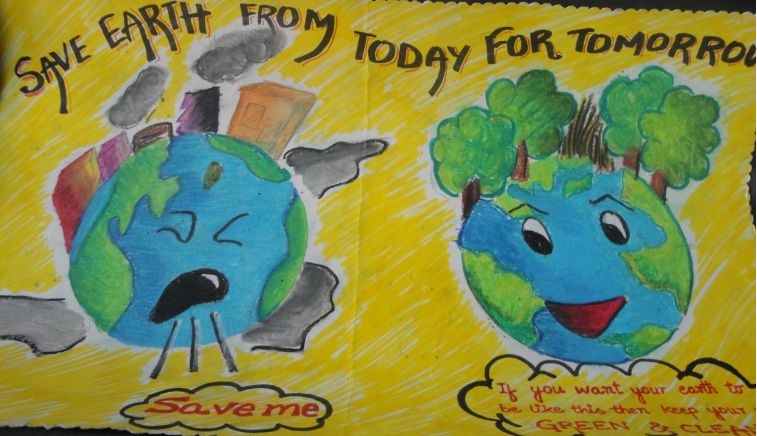
Up until I joined tunza.eco-generation.org I never knew World Earth Day (WED) was celebrated every April 22 nor was I aware that there was anything like World Environment Day (June 5) or World Water Day (March 22). The truth was that I never cared.

I first discovered tunza.eco-generation.org two year ago while rummaging the web for any ongoing essay and short story contests that Nigerians can (an opportunity I always grabbed to sharpen my writing skills and also evaluate myself). At that time, I was concerned about a number of things; if my writing actually made sense, how people felt about my work. My idea was that if I should win any contest or even get short-listed, it meant I was doing great (that never happened. An awful way to evaluate oneself).

Meanwhile, I decided to read a few articles on the website (there is always something new to read every day by the way). When I did, I found a new purpose to life greater than my hunt for bounty; our planet is dying and I was one of the murderers.

Like myself, there are millions of people out there who are unaware of how their behaviours change our planet. Many years ago, I knew the exact month to expect the rains, when it will stop and when harmattan will take over the mantle of leadership but that is no longer so.

Climates have change; earthquakes, volcanic eruptions, tsunami, erosions and melting of glaciers have taken over our environment. Why won’t the earth be annoyed? We keep taking and never give. Caring for the earth is not a government thing but the responsibility of everyone.

Yes, we have to cut down trees for timber, but what stops us from planting another to replace the one cut down? Why acquire more than you need and end up discarding many of them? Why can’t industries figure out better ways to manage their waste rather than dumping them into the sea? Why must we burn coal and fuel when the sun is there to give us cleaner energy?

The most disturbing and most prevalent especially in Nigeria is the culture of wastage (to show the world that you have ‘arrived’). People throw lavish parties with lots of food and drinks spilled. Same is the case every evening at drinking joints. People eat and drink and become drunk, leaving foods on their plate which are later collected into a dustbin.

At no other time has this crusade of attitudinal change been more relevant than today when parts of the world are gripping with food shortage. Even in Nigeria, there are still families that go to bed on empty stomach. The truth is that the earth is capable of supporting everyone’s dream but not their greed. We have approximately 7 billion people in the world in one planet, so consume with care.

I used to think I was an individual, what difference can I possibly make? But going through tunza.eco-generation.org I got ashamed of myself; youngsters––as young as fifteen and under––raising their words and living the talk to make our environment a better place. You may be just one person in 7 billion but believe me, there are tens of people that look up to you to model their lives. Live the change and it will trickle down.

More recently, an ambassador on the platform (Miss Bindu Bhandari) wrote about her interview with what she tagged ‘the real Eco-hero’. It was about a man, a refuse collector that goes ahead to sell the scraps he picked from the environment to recycling plants so as to generate money for his family’s upkeep. The people that do this kind of job are the ones we most often look down on but through her interview I discovered otherwise.

The action of the man helps remove wastes that are not biodegradable from the environment. If not for this great website, tunza.eco-generation.org I may still be basking in my ignorance environmental matters.

To end this write-up, I want to dish out 5 pieces of advice;
1) Don’t let a year pass without planting a tree or flower.
2) Reduce; while you dine, remember there are people out there who can’t afford to.
3) Re-use; all the old plastic and tyres can be put into other uses.
4) Insist on clean energy
5) Recycle; to reduce the rate at which new raw materials are mined


That refuse scavenger in you vicinity is an Eco-Hero. Who are you?

photo credit: Arushi Madan on tunza.eco-generation.org